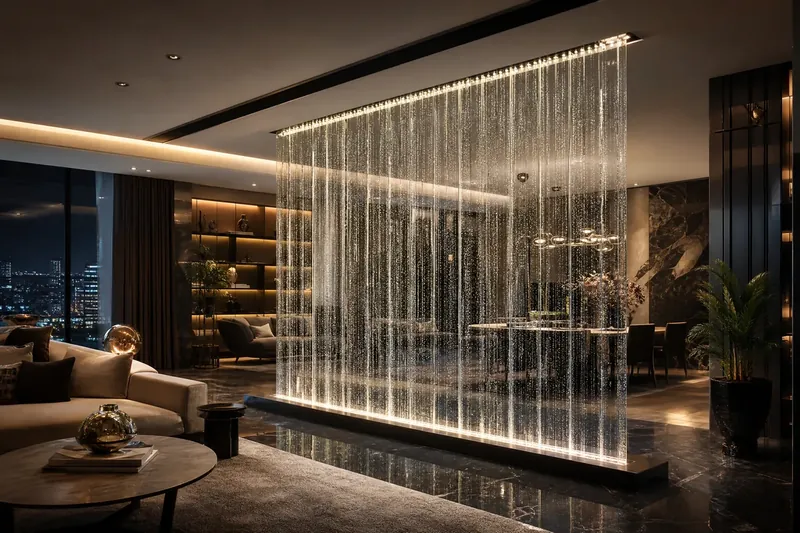
Choosing between a water-bubble curtain and other decorative water walls depends on priorities: transparency and kinetic light effects favour bubble panels, while textured water walls can emphasise privacy and sound masking. Key practical points are access for pump and filter maintenance, electrical protection, corrosion-resistant framing, and a lighting plan that complements natural daylight without creating glare. Ask your contractor about maintenance schedules, redundancy for pumps, water treatment routines, warranty on fittings and how the installation will interact with HVAC and cleaning cycles. For a tailored assessment and detailed specification, contact Homey Decor to review site conditions and match aesthetics with long-term performance.
The Role of Water Bubble Curtains & Walls in Space Division and Décor
A water bubble curtain or wall is a freestanding, transparent vertical panel filled with water in which calm, illuminated bubbles rise gently from the bottom to the top. This subtle, continuous motion and controlled lighting create a three-dimensional shimmer that preserves sightlines while introducing a soft kinetic quality to a room. Because the panel remains see-through, it acts more like a visual separator than an opaque barrier: it lets daylight pass, refracts light for dynamic highlights, and adds a tactile sense without blocking circulation or making a space feel smaller.
When planning an installation, think beyond the visual effect to the technical and operational needs. Panels require stable power, a secure water feed and drain strategy, and clear service access so pumps, diffusers, and filtration can be serviced without dismantling the artwork. Choose frame materials that resist corrosion and specify accessible panels or removable trim so routine cleaning and component replacement are straightforward. Lighting should be coordinated with natural light — use dimmable, warm-to-neutral color options and position fixtures to avoid direct glare on work surfaces or screens.
Practical design choices often come down to placement and use. A bubble panel can define a foyer from a living area while preserving an open-plan feel, or create a calming backdrop behind a reception desk that reads as sculpture from a distance. Prepare by taking site measurements, locating electrical runs and HVAC vents, and planning where service technicians will stand and store tools. Avoid common mistakes such as placing a panel directly in a high-velocity vent path, hiding service access behind built-in cabinetry, or specifying overly complex lighting sequences that are hard to maintain — simplicity in controls and easy access for upkeep make these features live well over time.
- Plan service access and removable trim for maintenance
- Locate dedicated power with proper protection and isolation
- Coordinate lighting temperature and dimming with daylight
- Check proximity to HVAC vents to prevent air disturbance
- Confirm frame material resists moisture and is easily cleaned
Frequently Asked Questions
How often will a bubble panel need maintenance?
Expect routine visual checks monthly, with mechanical and filtration servicing every few months. Frequency depends on local water quality and how heavily the panel runs; accessible fixtures reduce downtime and effort.
Can a transparent bubble panel provide privacy between rooms?
A transparent bubble panel preserves visual connection while softening detail; it blurs outlines and reduces direct sightlines but does not replace opaque partitions for full privacy.
Is installation possible in an existing home or office?
Yes, but plan ahead: confirm floor support, route electrical supply, find a nearby water source or tank, and ensure a technician can reach internal components. A clear installation plan prevents later disruption.
For a coordinated solution tailored to your space, explore related Homey Decor services and products, and browse Homey’s selected home products on Amazon. Homey Decor services | Homey on Amazon