Quick Planning: Practical Introduction
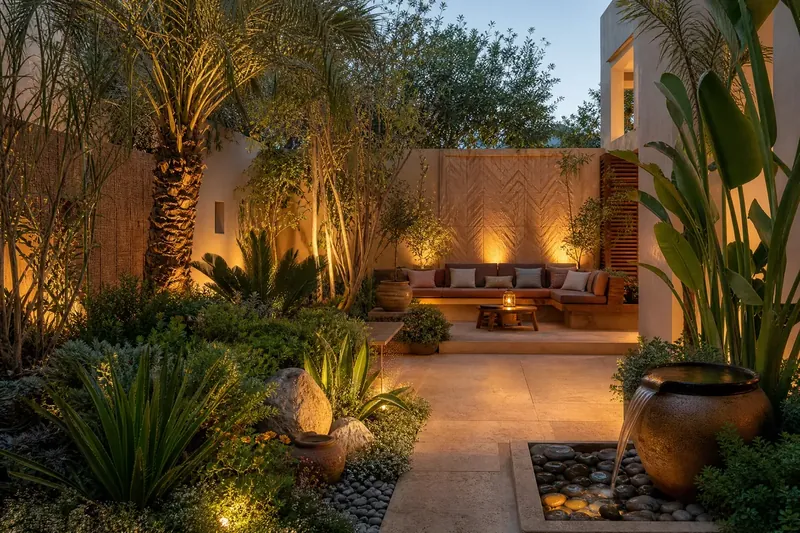
A small home garden can offer more than a pretty view — it can become an outdoor living room, a kitchen garden, and a private relaxation retreat. These guidelines are practical and direct: start with measurements, define primary functions (relaxation, dining, play, storage), then choose water-wise, low-maintenance elements to reduce upkeep.
Measuring and Analyzing the Space (Step One)
- Measure the space accurately in meters (m) and use centimeters for pathways; record wall lengths, door and window locations, sun orientation, and electricity and water sources.
- Draw a simple plan at a 1:50 scale or use a 3D design app to test furniture and plant layout before implementation.
- Local example (Egypt / Middle East): a square courtyard of 16 m² (4×4 m) needs a different layout than a 8 m × 2 m long narrow yard.
Zoning a Small Garden (Dividing Use Areas)
Rule of thumb: allocate 1–2 primary zones and 1–2 secondary zones. Typical examples:
- Seating/entertainment zone: 2.5×2.5 m (8×8 ft) for a small sofa and coffee table.
- Compact outdoor kitchen/grill: a vertical counter 60–90 cm (24–36 in) deep.
- Planting bed / raised bed: 20–40 cm depth suitable for vegetables and herbs.
- Pathway width 60–90 cm to allow access and maneuvering.
Techniques for dividing narrow spaces: - Multi-functional furniture (bench seating with storage, folding tables). - Vertical planting units to increase green area without sacrificing floor space. - Use different floor materials (composite decking, basalt pavers, gravel) to visually define zones.
Privacy Strategies for Tight Urban Spaces
- Vertical green screens or planter boxes 1.5–2 m high to filter direct sightlines.
- Arbors or timber panels with slats that allow light through while blocking view.
- Outdoor fabric curtains made from weather-resistant textiles on retractable rods.
- Decorative glass panels with a gentle water feature: consider a transparent vertical bubble-water panel with calm illuminated bubbles rising gently from the bottom to the top used as a privacy and visual element between garden and adjacent wall.
Safety notes: avoid toxic plants near play areas; see the Safety section.
Water-Saving Automatic Irrigation Systems for Small Gardens
Why choose automatic irrigation? It reduces waste and saves time. Suitable options for small gardens:
- Drip irrigation: excellent for planting beds and containers. Connect with 4–6 mm tubing (1/8–1/4 in) and low-flow emitters.
- Micro-sprinklers: suited for small lawn patches or larger plant clusters.
- Climate-aware smart controllers: connecting a smart controller or soil moisture sensor to a control platform like Homey Pro lets the system skip watering when it rains or when the soil is already moist.
Practical benefits: - Significantly lower water consumption when scheduled for early morning or evening. - Integration with weather stations or home weather data to automatically adjust schedules.
Installation tip: use simple pressure regulators and a coarse filter before the drip system to protect emitters. For electrical connections or main plumbing adaptations hire a qualified technician.
Comparison: Drip Irrigation vs. Manual Watering
- Water efficiency: Drip irrigation is superior.
- Smart control: Available with automated systems through smart controllers.
- Installation: Requires components and setup; manual watering is simpler but less efficient.
Low-Maintenance Plants for Shaded Areas and Limited Root Space
Plants that tolerate limited shade or restricted roots in containers:
- For partial to full shade:
- Aspidistra elatior (cast iron plant): tolerates shade and needs well-draining soil.
- Hedera helix (ivy): suitable for walls and vertical supports.
Shade-loving culinary herbs: e.g., sheltered basil in pots or marjoram.
For intermittent sun and narrow root spaces:
- Lavandula (lavender) and Rosmarinus officinalis (rosemary): fit containers and tolerate some drought.
- Punica granatum 'Nana' (dwarf pomegranate): a popular pot option in the region.
- Sedum and succulents: good for shallow pots and very low maintenance.
Horticultural tips: - Use a light, well-draining potting mix for containers; 20–40 cm depth is usually sufficient for many species. - Use a geotextile layer at the base to prevent soil loss through small drains. - Check plant suitability with a local nursery to confirm fit for your microclimate (northern vs southern Egypt, wind and salinity differences).
Smart Outdoor Lighting and Year-Round Seating Layouts
Lighting basics: - Choose warm LEDs (2700–3000K) for social areas. - Use weather-rated fixtures (IP44 or higher for pathways, IP65 for exposed locations). - Motion sensors, timers, and scenes controlled via Homey Pro or outdoor lighting controllers improve security and lower energy use.
Seating planning: - Comfortable seating for a small family: 2–3 seats with a side table, roughly 2–3 m² for the seating zone. - Use cushions and moisture-resistant fabrics with removable, washable covers. - Climate considerations for Egypt: provide fabric shades or shade trees to reduce summer sun.
Safety and Comfort for Children and Pets
Safety essentials: - Non-slip surfaces when wet and pathways at least 60 cm (24 in) wide for access. - Conceal or secure irrigation pipes and electrical equipment in conduits or lockable cabinets. - Use non-toxic plants in play areas; if a toxic plant is included, place it out of reach of children and pets. - Enclose water tanks or decorative water elements with a fixed fence; do not leave deep open water basins uncovered.
Additional comfort: - Movable shaded areas (pergolas or curtains) and good ventilation. - Soft surfaces or small rubber flooring for play areas.
Materials, Furniture, and Supplies to Inspect Before Purchase
- Check weather resistance (UV, humidity) for outdoor seating and cushion covers.
- Test irrigation fittings and drip filters for compatibility.
- Review plant care instructions and pot size requirements.
Decision Table / Checklist
| Goal | Recommended strategy | Complexity | Expected maintenance level |
|---|---|---|---|
| Save water | Drip irrigation + connected soil moisture sensor | Medium | Low after setup |
| Privacy on one wall | 1.5 m high planter box + fast-climbing ivy | Low | Medium (pruning) |
| Comfortable seating | Foldable bench + stowable table 2–3 m² | Low | Low |
| Plants in limited shade | Deep pots 25–40 cm with Aspidistra or shade herbs | Low | Low |
Pre-implementation checklist: - [ ] Measure the space and note sun orientation. - [ ] Choose primary zones (seating, planting, play). - [ ] Identify water and power sources and propose a secure wiring/pipe route. - [ ] Verify plant choices and their safety for children/pets. - [ ] Compare costs and water savings of manual vs automated irrigation. - [ ] Check warranties for equipment and outdoor-rated durability.
Amazon
For product ideas suited to your category (solar lighting, drip kits, outdoor pots, weather stations, furniture covers), review the public storefront and user reviews before purchasing: Amazon storefront
Note: this is a pointer to inspect the store and not a guarantee of product availability. Check product specifications and customer reviews and confirm suitability for your local environment.
Visual Plan (Photo & Media Suggestions)
Suggested assets for the project page: 1. A 3D view of a zoning plan for a small urban courtyard (example: 4×4 m) showing seating, planting, and circulation paths. 2. An illustrated comparison between a drip irrigation system and manual watering — showing small-diameter tubing, emitter points, and water-saving layout. 3. A visual table of low-maintenance plants (names, required soil depth, sun exposure) highlighting Eastern Mediterranean options. 4. A styled image of a smart outdoor bench with connected lighting and a Homey Pro interface on the control screen. 5. A decorative privacy element: image of a transparent vertical bubble-water panel — a transparent vertical bubble-water panel with calm illuminated bubbles rising gently from the bottom to the top — used as a divider between a courtyard and an adjacent wall.
Video placement recommendation: include a Homey/YouTube video carousel on the project page to feature official Homey tutorial or demonstration videos. Do not invent video titles — place a carousel linked to the official channel.
Frequently Asked Questions
Q: Are drip systems suitable for small pots? A: Yes. Drip systems can be adapted for pots using small fittings and low-flow emitters. Use small inline filters to prevent clogging.
Q: How can I ensure neighbor privacy without blocking light? A: Choose slatted screens, a transparent vertical bubble-water panel, or staggered-height planting to allow light while limiting direct sightlines.
Q: What is the best time to water to reduce loss? A: Early morning or after sunset to reduce evaporation. Connecting the system to a moisture sensor or weather data provides better control.
Q: How do I pick plants safe for children and pets? A: Exclude known toxic species near play areas. Ask a local nursery for a list of safe plants or consult a local horticulture expert.
Q: Can I connect garden lights to Homey Pro? A: Yes. Compatible smart lighting fixtures can be integrated with Homey Pro for scenes, schedules, and motion-activated control.
Q: What if my soil is waterlogged or saline? A: Use raised beds, a specialized well-draining mix, and salt-tolerant materials and plants. Consult a soil specialist for extensive issues.
Homey Consultation
If you want a detailed plan compatible with Homey Pro (integrating irrigation, lighting, and environmental sensors), our team can provide a design consultation and a technical plan tailored to your space and budget. Book a Homey consultation for safe planning and professional local installation.
References
- Small garden design guidance (Royal Horticultural Society) (https://www.rhs.org.uk/garden-design/small-gardens)
- Small garden design ideas (The Spruce) (https://www.thespruce.com/small-garden-design-ideas-4125860)
- Small garden planning and guidance (Better Homes & Gardens) (https://www.bhg.com/gardening/landscaping/small-gardens/)
Practical Implementation and Ongoing Care
When turning a compact yard into a dependable outdoor room, focus first on substrates and containers that suit constrained root space and erratic rainfall. Check how quickly water soaks in by pouring a measured amount onto the soil and observing percolation: slow drainage calls for raised beds or pots with a drainage layer and a free-draining mix. Select containers with enough volume for the plants at maturity and prefer lightweight composite or fibreglass for easy rearrangement. For climbers and screens, use slender support frames anchored into the ground or walls rather than relying solely on heavy planters, so the structure stays secure in wind without occupying valuable floor area.
Establish a simple seasonal routine to keep the garden healthy without overwhelming maintenance. Group plants with similar moisture needs together so a single routine or irrigation line serves each cluster efficiently. Plan two or three brief care moments each season: prune spent growth, replenish surface mulch to reduce evaporation, and check irrigation outlets for blockages. For lighting and movable furniture, choose pieces that are weather-resistant and modular; this lets you adjust the layout as plants fill out or as you need more open floor for gatherings. If you prefer professional help with concepts or sourcing, Homey Decor can provide recommendations tailored to small outdoor spaces.
When small problems appear, tackle them with low‑impact fixes. For early pest pressure, use physical barriers and hand removal before reaching for chemical treatments. If a planter dries out quickly, increase its organic content or switch to a reservoir-style pot that supplies water from below. For privacy without shutting out daylight, experiment with semi-opaque screens, layered planting at staggered heights, or trellises placed a short distance from windows so light scatters while sightlines are softened.
- Test drainage in a new bed or container before planting; add coarse material and a free-draining mix if water puddles for more than a few minutes.
- Group pots by water requirement and place them on trays or saucers to simplify watering and avoid runoff onto neighboring areas.
- Choose multipurpose furniture (bench storage, fold-down tables) to increase functionality without consuming space permanently.
- Top-dress soil with mulch after planting to cut watering frequency and suppress weeds; refresh the mulch once or twice a year.
- Anchor tall planters or lightweight structures to a fixed point to prevent tipping in strong gusts and protect nearby windows or plantings.
Frequently Asked Questions
How deep should containers be for vegetables and larger shrubs?
Aim for pots that comfortably accommodate the mature root system: shallow herbs need modest depth, while fruiting vegetables and larger shrubs benefit from much deeper volumes to support roots and moisture reserves. When in doubt, choose a deeper option—it reduces the need for frequent watering and supports healthier growth.
What are the easiest ways to cut maintenance time in a tiny garden?
Select long-lived, hardy plants; use a dense layer of mulch; group species by how much water they need; and install a simple timed watering device so irrigation is consistent. Also favour durable surfaces and modular furnishings that don’t require seasonal storage or complicated upkeep.
How can I create screening without making the area feel darker?
Use materials that let some light through—slatted panels, translucent screens, or planting that climbs on an open framework. Place taller elements slightly away from windows so daylight can filter around them, and balance screening with reflective surfaces or lighter paving to preserve brightness.
For a coordinated solution tailored to your space, explore related Homey Decor services and products, and browse Homey’s selected home products on Amazon. Homey Decor services | Homey on Amazon