Practical introduction
If you're renovating a kitchen in a luxury villa or planning a custom kitchen, this guide delivers practical, actionable decisions on material selection that balance durability, ease of maintenance and a premium look. Read the sections below to learn which cabinet core suits Egypt and the region's climate, which countertops withstand daily use, and what daily care each choice requires.
Choosing cabinet cores: Solid wood, engineered plywood, MDF
- Solid wood: natural look and a luxurious feel; excellent for solid fronts and carved doors. Prone to warping (swelling/shrinking) in humid environments if not correctly treated. Best for air-conditioned areas and projects that demand fine detailing and finishes that showcase wood grain.
- Plywood (engineered): an excellent balance of rigidity and moisture resistance compared with solid composite boards. Offers better dimensional stability when exposed to humidity fluctuations and cooking heat, so it is a common choice for high-quality cabinets.
- MDF (medium-density fiberboard): easy to finish and paint, suitable for fronts where visible wood grain is not required. There are moisture-resistant MDF variants (MR/MDF) and high-density MDF — but generally it is less water-resistant than plywood and its edges must be protected to avoid water absorption.
Homey practical tip: use plywood for upper and lower cabinet carcasses and solid wood for doors or selected fronts to provide a premium feel, with edge sealing and moisture protection near plumbing or washing machines.
Moisture resistance and service life comparison
- Best moisture resistance: engineered plywood (with moisture-resistant layers and adhesives) > moisture-resistant MDF > solid wood (if untreated).
- Longest practical service life with maintenance: solid wood with good finish ≈ high-grade engineered plywood > MDF.
Practical note: in hot, humid Egyptian climates, avoid using untreated MDF at the cabinet base near the floor or close to water sources. Consult a cabinetmaker to confirm the adhesive type used in plywood if it will be near wet areas.
Luxury countertops: Quartzite, marble, engineered quartz
- Quartzite (natural): a blend of natural beauty and high hardness — approaches or exceeds engineered quartz in scratch resistance, and handles heat better than resin surfaces.
- Natural marble: a luxurious, unique veined appearance; more vulnerable to acids, scratches and etching, needs protection and is less forgiving with stains and citrus.
- Engineered quartz: a mix of natural stone and polymer resins; generally scratch-resistant and easy to maintain, but less heat-resistant because the resins can suffer thermal shock.
Professional summary: for the combination of luxurious appearance and everyday durability, quartzite or engineered quartz provide the best balance. Marble remains a premium choice for lower-use areas or as an island statement panel.
Scratch and heat resistance: what to expect
- Scratch resistance: quartz and quartzite rank highest on hardness scales (visual reference: hardness ratings and field observations), while marble is lower — it may show lines and scuffs. For woods: solid wood can scratch but can be sanded and refinished; MDF cannot be repaired nearly as easily.
- Heat resistance: dense natural stones (quartzite, granite) tolerate stove heat better than engineered quartz. Nonetheless, avoid placing hot pots directly on any surface: thermal shock can damage a material or a resin finish.
Practical recommendation: use trivets and heat-protective pads on quartz; designate work zones near ovens with heat-tolerant surfaces or install a stainless/INOX plate above the countertop in those zones.
Daily maintenance protocols: natural stone vs engineered surfaces
- Natural stone (marble, quartzite, granite): daily wipe with a soft cloth and warm water plus a pH-neutral cleaner. Wipe acidic spills (lemon, vinegar) immediately to avoid etching. Reseal according to the stone's porosity — typically every 6–18 months depending on use and stone type (perform a spill test to check absorption).
- Engineered quartz: similar daily wiping; use a mild surface cleaner. Avoid cleaners with strong bleaches or harsh stripper chemicals. For stubborn stains use a gentle paste of water and baking soda.
- Wood surfaces: dry spills immediately, avoid heavy water use on panels; apply penetrating oils/conditioners once or twice a year if the finish is natural.
Daily practical protocol (transferable to household service teams): morning quick wipe with a pH-neutral cleaner; after cooking, wipe grease spots with a microfiber mop; end-of-day check cabinet edges around the fridge and sink for leaks.
Cabinet finishes: lacquer, acrylic, veneer and their effects
- Lacquer: a smooth glossy or soft-matte finish that provides an even, easy-to-clean surface. With heavy use, fine scratches may appear on high-gloss surfaces, but these can be professionally refinished.
- Acrylic: very high gloss and modern appearance, good stain resistance and excellent ease of cleaning. Requires protection from deep scratches because repairs often require replacement of the front panel.
- Veneer: real wood veneer over plywood or MDF — gives a natural look while reducing cost and weight. Vulnerable at edges to moisture if not well sealed.
Visual and practical effect: high gloss reflects light and feels luxurious, while matte conveys warmth and depth. For high-end kitchens, mixing glossy fronts with wood veneer balances aesthetics and function.
Balancing cost vs durability: a mixing strategy
- Practical rule: invest in materials that face direct, heavy use (worktops, areas close to sink and stove, drawer hardware) and economize on decorative elements (upper, low-use rows, hidden sides).
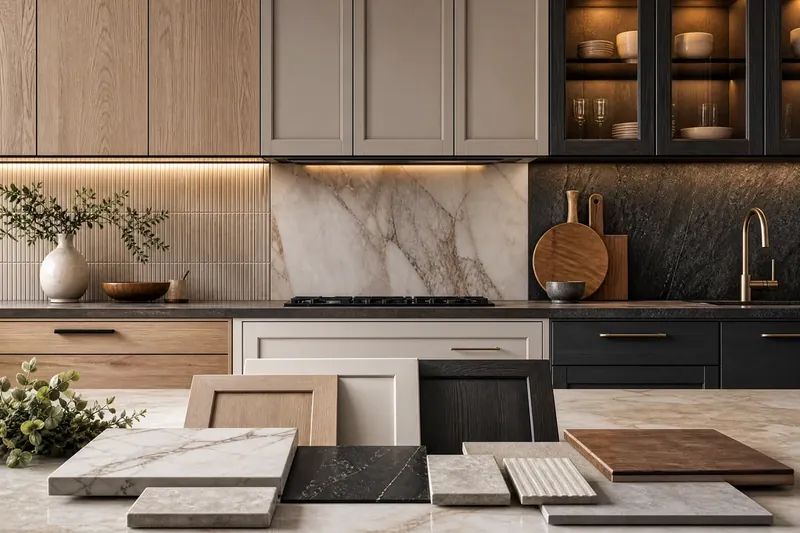
- Practical example (Egypt/Gulf): use quartzite or engineered quartz for worktops, marble for an island panel or accent, solid wood fronts for visual doors, and plywood for internal carcasses.
Cost-benefit: choosing high-quality plywood may save 10–25% compared with solid wood while maintaining durability close to the pricier option if edge finishing and workmanship are professional.
How to assess a kitchen’s resistance to warping, staining and thermal shock
- Engineering and layout: provide ventilation clearance around cooktops, and a standard backsplash system over cooking areas.
- Edges and protection: ensure water-resistant edge banding around sinks and presence of drainage channels inside lower cabinets.
- Dedicated work zones: designate alternative countertop areas around baking ranges and ovens that are prepared to tolerate high heat.
- On-site tests before installation: inspect material samples in situ for one week to note color shifts under daylight and reaction to local humidity.
Important warning: for any structural changes or electrical/plumbing/gas connections, use a licensed professional to verify local safety requirements.
Decision checklist: material selection evaluation table
| Criterion | Solid wood (Fronts) | Plywood (Core) | MDF | Marble | Quartzite | Engineered quartz |
|---|---|---|---|---|---|---|
| Heat resistance | Moderate (use trivets) | Good as structural core | Low to moderate | Good (watch for stains) | Very good | Moderate (sensitive to high heat) |
| Hardness / scratch resistance | Repairable | Structurally good | Low | Low | High | High |
| Daily maintenance effort | Low to moderate | Low | Low | Moderate to high | Low to moderate | Low |
| Practical expected lifespan | Long with maintenance | Very long | Medium | Long with protection | Very long | Long with protection |
| Relative cost (order) | High | Medium | Low | High | High | High to medium |
Notes: the above values are general assessments and vary by supplier quality and finish.
Execution checklist before installation
- [ ] Inspect material samples on-site in daylight for 3–7 days.
- [ ] Secure edge protection for MDF or choose plywood instead in wet areas.
- [ ] Allocate space and ventilation for cooking systems.
- [ ] Plan hotspots for hot pots and protective handles/trivets.
- [ ] Establish a maintenance schedule and user instructions (daily/weekly/annual worksheets).
- [ ] Consult Homey technicians for final measurements, installation planning and cost audit.
product categories and store monitoring
Below are product categories recommended for post-design checks (field verification of product samples before purchase is advisable): - Kitchen countertop care & cleaning kits - Stone sealing products - Cabinet hardware & soft-close hinges - Under-cabinet LED lighting strips - Scratch repair markers for wood
We suggest browsing the Amazon storefront for model comparisons and user reviews: Amazon storefront. Do not assume item availability without checking the store's stock.
Photo and video plan for presentation
Original images suggested to show materials and visual comparisons (all photos should be high-resolution with natural lighting and staged to reflect Egyptian/Gulf environments): 1) Side-by-side comparison photo between matte lacquer fronts and glossy lacquer fronts — angle showing light reflection and fine finish detail on the same cabinet run. 2) Close comparison between etched/blemished marble and a flawless quartz counter — close-up showing porosity and texture under room lighting. 3) Cross-section display of materials showing plywood vs MDF vs solid wood core with moisture-resistance and crack-risk annotations — photographed with explanatory keys. 4) An execution photo of an actual Homey-designed kitchen showing mixed materials: a quartzite island, veneer cabinets and serviceable worktops. Video: a carousel on Homey's YouTube/channel showing stages of design, measurement and installation (use existing videos on the channel as items in the carousel — do not invent new titles), with a hands-on walkthrough from the Homey team on how to select materials and inspect samples.
Frequently Asked Questions
1) What is the practical difference between plywood and MDF for cabinets? - Plywood offers better moisture stability and structural strength; MDF is easier to finish but sensitive to water at the edges.
2) Can I place hot pots directly on stone surfaces? - Not recommended. Even natural stone can suffer thermal shock or staining; use protective trivets.
3) How often should I seal a natural kitchen stone? - A practical test is preferred: pour water and observe absorption. Generally every 6–18 months depending on stone type and usage intensity.
4) What should I choose if I want a marble look with better durability? - Engineered quartz or quartzite provide marble-like aesthetics with greater durability and density.
5) How do I keep glossy finishes looking without scratches? - Use gentle cleaners, avoid abrasive products, apply protective pads under heavy items and make sure appliances have soft feet.
6) Can I mix solid wood fronts with plywood carcasses without issues? - Yes, this is a common practice to combine appearance and economy, paying attention to edge detailing and adhesive quality.
7) How do I test stain resistance of a new surface before installation? - Request a sample large enough to test, place typical stains (coffee, oil, lemon juice) for several hours, then wipe and evaluate the surface behavior.
Conclusion and invitation to consult Homey
Choosing the right blend of materials depends on daily usage patterns, the site climate, and the expected budget. For help handling the details: Homey Custom Kitchen Design Service, Homey Luxury Countertop Installation, Homey Precision Cabinetry Consultation and Homey Interior Spatial Planning are available to assess your site, arrange signed samples, and provide final measurements. Book a Homey consultation to plan a material selection tailored to your aesthetic and operational needs.
References
- Types of Countertops overview (Home Depot) (https://www.homedepot.com/c/ab/types-of-countertops/9ba683603be9fa5395fab90f68e434e)
- Best Kitchen Countertop Materials (United Granite NC) (https://unitedgranitenc.com/blog/best-kitchen-countertop-materials)
- Best Kitchen Cabinet Materials (Kitchen Renovations Perfected) (https://kitchenrenovationsperfected.com/best-kitchen-cabinet-materials/)
Practical integration and installation advice
When planning a luxury kitchen, think of materials by task rather than only by appearance. Reserve the most delicate yet beautiful surfaces for areas that are mostly visual—an island face, a breakfast bar or a display shelf—and put more resilient options where heavy chopping, hot pans and frequent spills occur. Pay attention to where seams, joints and appliance edges will fall: placing a seam away from a hob, sink or heavy-traffic prep zone reduces the chance of staining, thermal stress and accelerated wear.
Good long-term performance depends as much on installation details as on the material choice. Ask your fabricator which adhesives, edge treatments and seals they will use and request a finished sample or mockup for critical junctions (sink cutouts, cooktop gaps and backsplash transitions). During handover, verify door and drawer alignment, confirm that exposed edges are sealed, and agree on a simple maintenance routine tailored to each surface so small issues are caught early.
- Specify moisture-tolerant cores or protected construction at plinths, below sinks and near dishwashers; if in doubt, move higher-risk materials away from direct plumbing exposure.
- Require sealed and taped cabinet edges and countertop seams; insist on a planned seam layout so joins are placed in low-use locations and can be serviced if needed.
- Assign the toughest surfaces (heat- and scratch-resistant) to primary prep areas and keep visually striking but softer materials for less-used zones to balance beauty and durability.
- Request color-matched touch-up materials and a small spare panel from the supplier to make repairs simple and consistent later.
- Ensure adequate ventilation and clearance around ovens and tall appliances; thermal cycling and trapped humidity are common causes of finish failure and warping.
Frequently Asked Questions
Can I combine different countertop materials in one kitchen?
Yes. Mixing materials lets you match performance to use: choose robust, low-maintenance surfaces where you cook and prep, and reserve more delicate stone for islands or serving areas. Keep the palette coordinated, plan seam positions carefully and allow for different thermal and expansion properties at junctions.
What practical steps reduce the risk of cabinet warping in humid conditions?
Use cores and finishes designed for humidity in vulnerable locations, make sure edges and cut-outs are properly sealed, and provide good room ventilation or climate control. Clear communication with your cabinetmaker about adhesives and construction details also helps prevent surprises after installation.
What should I check during the final site inspection before sign-off?
Confirm that doors and drawers operate smoothly, exposed edges and cut-outs are sealed, seams are positioned as planned, appliances have correct clearances, and that the installer has left any recommended maintenance notes or spare touch-up materials. A quick functional test of sinks, taps and integrated appliances will reveal most installation issues.
For a coordinated solution tailored to your space, explore related Homey Decor services and products, and browse Homey’s selected home products on Amazon. Homey Decor services | Homey on Amazon