Short practical introduction
Refining ceilings with fiber‑optic lighting creates a luxurious, calming atmosphere in living rooms, master bedrooms, and home theaters. This guide explains what you need to know before purchase or design: how star ceilings work, how to integrate them with cove (perimeter) lighting, essential safety and ventilation requirements, and practical maintenance advice for Egypt and the wider Middle East—with tips that apply in any market.
What is a fiber‑optic "star ceiling" and how does it work?
A star ceiling is a ceiling panel (typically gypsum board or fixed wooden panels) drilled with thousands of tiny holes where fiber‑optic ends are inserted. These fiber ends carry light from a central light source called a light engine or illuminator. The fiber tips appear as fixed or gently glowing points of light in the ceiling. The light engine houses high‑efficiency LEDs or modified halide lamps; for full color effects, RGBW LED engines are used.
How LED light engines work in fiber‑optic systems
- Source: High‑output focused LEDs or RGBW LED modules act as the central source and illuminate many fiber lengths at once.
- Light distribution: Light enters the input end of the fibers (usually bundled in a harness) and travels through the fiber to the tips.
- Control: Dimmers and smart controllers manage color modes, twinkle speed, and scene programs.
- Cooling and ventilation: LED engines need adequate ventilation and tidy installation inside an accessible service box to avoid heat buildup.
Integrating fiber optics with perimeter & cove lighting
- Color harmony: Use an RGBW light engine with the same color palette as the LED strips in the cove to create smooth color transitions.
- Circuit separation: Fiber networks and hidden LED sources usually run on separate circuits but can share a unified controller (DMX or smart home system) for coordinated control.
- Technical points: Provide an accessible service box at cable entry and plan for a 10–20% spare length of fiber for future repairs or updates.
- Reflective materials: In the cove, use semi‑gloss reflective surfaces to enhance light transition without distracting glare.
Room‑by‑room applications: Home theater, master bedroom, and reception lounge
- Home theater: Higher star density (for example 500–2,000 stars depending on room size), dimming control and cinematic scenes, and finer‑diameter fibers for sharper point definition (see comparison table).
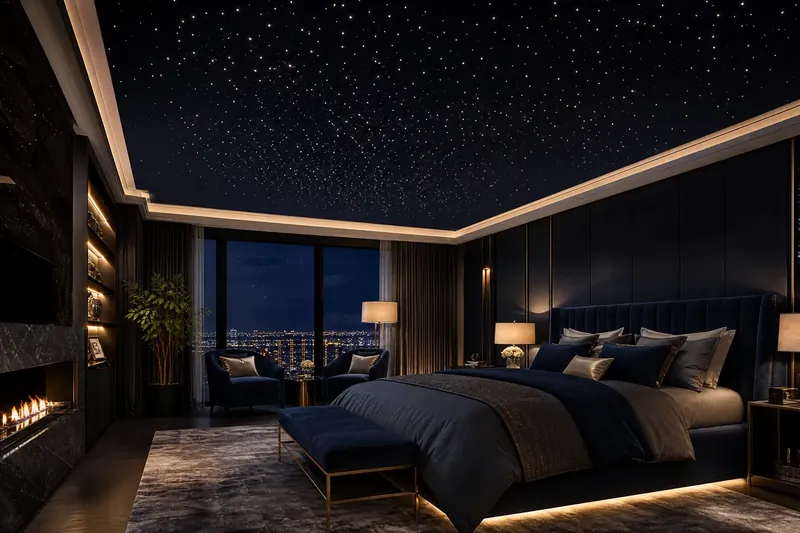
- Master bedroom: Spread stars more sparsely to create a soft canopy effect; combine with a warm LED strip in the cove for a soothing ambiance.
- Reception lounge / foyer: Consider a radial/twinkle wheel pattern around the center with ambient perimeter lighting to highlight architectural features.
Fire, electrical and thermal ventilation requirements (basic rules)
- Essential: Always check local regulations and hire a licensed electrician to inspect load capacity and dimmer circuits.
- Fire protection: Use fire‑resistant ceiling materials in public areas, keep clear evacuation routes, and ensure access to the service box to prevent overheating and reduce fire risk.
- Ventilation: Mount LED engines in enclosures that have ventilation openings or small fans if the thermal classification is high.
- Circuit separation: Separate general lighting circuits from fiber and light‑engine circuits to simplify maintenance and emergency procedures.
Maintenance and access to light engines and harness connections over time
- Accessible service box: Always design an access panel near the light engine, with spare cable length for future fixtures.
- Replacing lamps/engine: Test the engine annually; most LED engines are long‑lived but require cooling and connector checks.
- Cleaning fiber ends: Do not use liquids or abrasive materials on fiber tips; clean dust with a soft dry cloth.
- Documentation: Keep a diagram above the ceiling indicating tip locations and fiber routes to simplify later modifications.
Advanced practical effects: twinkling, twinkling wheels, RGBW, and shooting stars
- Twinkling: Achieved with controller programs or timed modules inside the engine; you can adjust density and speed.
- Twinkling wheels: A programmable rotating pattern simulated by the controller to create a circular motion effect.
- RGBW and color gradients: Full color control allows moving from warm daytime (around 3000K) to cool evening colors with static or animated programs.
- Shooting stars: Made by extending short, spaced fibers and sequencing them via the controller to create motion.
Common components to choose from: fiber types, engines, and tools
- PMMA fibers (plastic) are common for indoor projects; available in different diameters that affect the apparent point intensity.
- LED engines: Choose an engine sized for the number of fibers, with adequate color control and enough outputs for multiple harnesses.
- Tools: harness cutters, termination tips, service boxes, mounting accessories, and spare lamps.
Comparison table: PMMA fiber diameters, LED engine capacities, and typical installation by room
Explore the matching Homey Decor service
Homey plans fiber-optic ceiling lighting with carefully distributed light points, suitable controls, service access, and a finish that fits the room.
Galaxy Ceiling stars (Optical fibers) ←| Fiber diameter (mm) | Approx. point intensity | Recommended engine size (W) | Typical installation by room |
|---|---|---|---|
| 0.75 mm | fine, soft point | 10–30 W (per grouped sets) | Home theaters: high density, fine holes |
| 1.0 mm | clear, balanced point | 30–60 W | Master bedrooms: moderate distribution, spaced points |
| 1.5 mm | bold, bright point | 60–150 W | Large reception rooms: fewer points but higher brightness |
Note: Numbers are approximate for design purposes—the correct sizing depends on fiber lengths, light attenuation over distance, and number of tips. Consult a specialist to confirm capacity (see references).
Pre‑purchase / pre‑installation checklist
- Does the space require high star density or a scattered effect?
- Do you want shared color control with the cove lighting? (Yes/No)
- Is there an accessible service box close enough for the light engine?
- What is the maximum fiber length needed for your layout? Add 10–20% spare length.
- Do local regulations require fire‑resistant materials or special electrical specifications?
- Will you need future access for maintenance or system expansion?
Field examples — practical points for Egypt and the region
- Cairo villa: We used 1.0 mm fibers above the master bed with an RGBW engine synchronized to a warm LED strip in the cove to produce a "twilight sky" scene.
- Alexandria reception room: Engine station located in an adjacent service room with a dedicated service box and ventilation openings to minimize engine temperature.
Child safety and proximity to water protection
- Avoid placing fiber ends where children can reach or tamper with them unless protected by suitable covers.
- If the system is designed near water features, such as a transparent vertical bubble‑water panel with calm illuminated bubbles rising gently from the bottom to the top, follow electrical insulation standards and request certified plumbing and electrical inspection.
Amazon
To research harness cutters, fiber kits, and LED engines for review, you can browse the Homey storefront on Amazon for product options: Amazon storefront (We recommend reviewing specifications and user reports and requesting a technical review before purchase.)
When to hire professionals and when DIY is possible
- Hire licensed gypsum contractors, electricians, and structural engineers if modifications include cutting into slabs or changing ceiling loads.
- Trimming fiber ends and installing self‑contained fiber kits may be feasible for experienced in‑house teams when working on pre‑installed gypsum panels.
Homey recommendation for design and smart‑system integration
If you want a detailed plan tailored to your space or to integrate fiber optics with the Homey Smart Home Automation Hub, book a Homey Lighting Design Consultation or request Homey Custom Interior Installation Service. Our team can survey the site, specify the correct engine and fiber types, and produce a long‑term maintenance plan.
Frequently Asked Questions
Q: What is the difference between PMMA fibers and glass fibers for star ceilings? A: PMMA (plastic) fibers are more flexible, easier to cut, and are commonly used indoors; glass fibers handle longer runs and higher temperatures but are more expensive and require specialized tools.
Q: How large should the service box be? A: It depends on the LED engine and harness size; typically allow an enclosure around 30×30×20 cm or larger depending on the engine specifications. Follow the manufacturer's instructions.
Q: Can fiber ceilings be integrated with smart dimming systems? A: Yes—choose an engine that supports control protocols (DMX, 0–10V, Zigbee, or IP interfaces) to coordinate scenes with cove lighting.
Q: How long do PMMA fibers last before brightness loss? A: Fibers don't "burn out" like lamps, but brightness can diminish over very long runs or if exposed to direct sunlight. Good design accounts for fiber length and adequate source power.
Q: What basic steps prevent LED engine overheating? A: Provide proper ventilation, leave clearance around the engine, avoid enclosing it in an unventilated cavity, and add small fans where necessary.
Q: Can moving effects be run from one engine or do I need multiple engines? A: Modern advanced engines or DMX systems can handle multiple effects across harness groups, but large projects may benefit from multiple engines to reduce optical loss and improve control granularity.
Q: What should I budget for annual maintenance? A: Annual checks for optics and engine health, dust cleaning, controller testing, and replacement of consumables as needed.
Conclusion and invitation to consult Homey
A well‑designed fiber‑optic star ceiling increases property value and creates a customizable, luxurious night‑sky atmosphere. Before installation, document the space, define control and ventilation requirements, and consult Homey for design and intelligent system integration. Book a Homey Lighting Design Consultation to start a detailed plan suited to your villa or project.
References
- Product and star‑ceiling installation pages for more technical details:
- https://www.fiber-optics.com/products/star-ceilings/
- https://thefiberopticstore.com/pages/any-tips-on-installing-fiber-optic-stars-in-a-sheet-rock-or-finished-ceiling
- https://nyceiling.com/product-lines/stars
Practical planning, installation and upkeep tips
Successful implementation depends more on thoughtful access and coordination than on the number of points. Reserve a clearly reachable service compartment for the light source and any control gear early in the design stage, and plan routes for fiber bundles that avoid tight bends and hot zones. Before closing the ceiling, perform a full lighting test with the final controller to confirm color balance, uniformity and any dynamic effects; correcting faults is much easier before plaster or panel finishes are fixed in place. Homey Decor advises treating the service area as part of the visible design: make it accessible but discreet so future servicing is straightforward.
Finishing choices and small details make a big visual difference. Select fiber tip diameter to suit the room’s scale and how close occupants will be to the ceiling—finer fibers read as pinpoints from a distance, while thicker tips produce larger, softer glows. Use small collars or matte‑finish counterbores around each opening to eliminate distracting halos, and protect tip ends during finishing to avoid dust or paint contamination. Keep the light engine ventilated and allow tidy cable management so swaps or upgrades can be done without removing finished surfaces.
- Design and position an accessible service box for the illuminator and controllers before ceiling construction begins, and plan simple, labeled cable paths from it to each fiber bundle.
- Protect and label every fiber bundle and leave modest extra length at the service point so individual fibers can be re‑terminated if needed.
- Test the complete system with the final dimmer/controller and color settings before permanently fixing ceiling panels or applying final paint.
- Use matte or recessed collars at fiber exit points to reduce glare and achieve a crisp, uniform appearance from typical viewing positions.
- Schedule simple visual checks and keep the service box free of dust; ensure the illuminator has unobstructed airflow and easy access for maintenance.
Frequently Asked Questions
How often should I check the system and what should I look for?
Perform a visual inspection at least once a year and after any unusual heating, electrical work or dust events. Look for reduced brightness, uneven star appearance, discoloration, or dust accumulation at the illuminator; if any of these appear, clean accessible filters or vents and run a full test sequence to diagnose whether a fiber or driver needs attention.
Is a star ceiling a realistic DIY project?
A basic small installation can be completed by an experienced DIYer who is comfortable cutting ceiling panels, drilling precise holes, and following low‑voltage wiring practices. However, integrating the illuminator into central ventilation, coordinating with home automation, or creating dense multi‑effect designs usually benefits from a professional who can guarantee access, safety and consistent appearance.
For a coordinated solution tailored to your space, explore related Homey Decor services and products, and browse Homey’s selected home products on Amazon. Homey Decor services | Homey on Amazon